
“Let down, perhaps, by the mainstream media, 21 percent of people under 30 say they are learning about the campaign from satirical sources like “The Daily Show” and the late-night television monologues, up from 9 percent in 2000, according to a Pew Research Center study released in January….
“ ‘The premise of any joke delivered by oddball newscasters is that they’re making fun of the media’s treatment of news as much as they are the subjects of the news,’ [Mo Rocca, formerly of ‘The Daily Show’] said. ‘And if there’s one thing that everyone can agree on, it’s that, right or wrong, they hate the press.’”
-
The Week That Wasn’t: Fake News Is More Popular, and More Trusted,
Than Ever.
-- The New York Times, October 3, 2004
Has the US Found Links Between Iraq and al Qaeda? (October 2003)
Fox viewers who say yes 67%
PBS/NPR viewers who say yes 16%
-- Outfoxed: Rupert Murdoch’s War on Journalism
Jim Lehrer: Mr. President, new question. Two minutes. Does the Iraq experience make it more likely or less likely that you would take the United States into another pre-emptive military action?
George Bush: I would hope I never have to. I understand how hard it is to commit troops. Never wanted to commit troops. When I was running -- when we had the debate in 2000, never dreamt I'd be doing that.
But the enemy attacked us, Jim, and I have a solemn duty to protect the American people, to do everything I can to protect us….
Jim Lehrer: Senator Kerry, 90 seconds.
John Kerry: Jim, the president just said something extraordinarily revealing and frankly very important in this debate. In answer to your question about Iraq and sending people into Iraq, he just said, "The enemy attacked us."
Saddam Hussein didn't attack us. Osama bin Laden attacked us. Al Qaeda attacked us….
-- The Presidential Debate, October 1, 2004
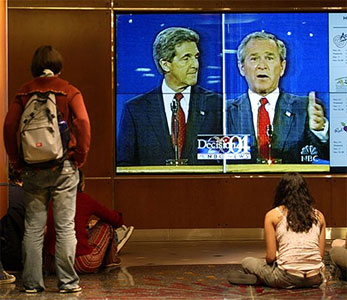 |
 Seattle, Wednesday, October 13, 2004 -- Students at the University of Washington watch the third presidential debate in the Husky Union Building. |
Photograph by Ted S. Warren/AP Photo |
"Yes, we have been showing a lot of blood, there is no denying it," said Maher Abdallah, head of International Affairs for Al-Jazeera Television, based in Qatar. "Is it civilized to kill hundreds of thousands of people to civilize them, but uncivilized to show some of those dead? Will someone explain this to me? How can you kill hundreds of thousands to civilize them, and you don’t even bother to count the dead? Yet, you expect me to follow suit? When Al Jazeera shows a couple of pictures of dead and mutilated bodies, suddenly we are uncivilized."
While Western media, especially the New York Times, have acknowledged they were misled about the reasons for going to war in Iraq and are now more critical of US policy than they were at the start of the war, Al-Jazeera has been attacked for its bias, Mr. Abdallah argued. "When we say it, we are instigating. When CBS does it, or the Washington Post, nobody talks about treason. What we’ve been doing is showing the same thing, though exclusively Al-Jazeera."
-- The World Editors’Forum, Istanbul, June 2, 2004
In 1989 I had an experience that shook me deeply. Sitting on the New York City subway, I began to look at the photographs posted throughout the car above the passengers across from me, and I began to wonder if what they represented actually existed. Was the man photographed speaking at the podium ever there? Did he exist? What of the people shown in business suits, in a taxi or on a picnic? Did they exist? And I began to sweat, so nervous was I that my system of referents was being challenged. It is an experience that I describe in the book In Our Own Image: The Coming Revolution in Photography.
Now, fifteen years later, when I sit on the New York City subway I no longer even imagine that what I see refers to anything that exists. I think of the images no longer as referents but as “desirents.” Each image must exist in some way to make me want to purchase the product described, to “know” more about it, or to “brand” it so I will recognize it next time I see the name again. Whether the people or places depicted actually existed is never the point.
When I read magazines and newspapers I have similar feelings. The pictures are published so that the publication looks good, so that its “personality” is established, its desirability enhanced. I am suspicious of all of the images, wondering what the motivation was to concentrate only on violence, to contort celebrities into sexual poses, or to make one politician look like an idiot while another looks distinguished. And I wonder at the conventions which make us think that someone is violent, sexy, idiotic or distinguished. Because I know that when I travel to these same places, or meet these same people, they are usually dramatically different from the ways in which they are shown in the published photographs.
Only rarely do I feel that the photographs offer a real insight into a person, a situation, an event. They may become icons to a cause, but the cause generally has already been conceptualized without the help of that specific photograph. They may evoke desire, but when they do so it is usually consciously done, part of a campaign or a provocation. Photography, like all mass media, is disingenuous.
Perhaps as a reaction, even a revolution, to the manipulations foisted upon the public, opinion now has increasingly replaced journalism (it is also cheaper). Fox News, behind its mottos of“Fair and Balanced” and “We Report, You Decide,” has otherwise barely maintained the façade of journalism. The Internet, with its thousands of sites, also does the cheap, more expedient thing, spewing out opinions with very little reporting. The New York Times and Washington Post both apologized to their readers for having trusted the Administration too much, and for having replaced reporting with a misplaced faith.
So when Al Jazeera comes along with its own brand of pan-Arab flag-waving, empathetic to its constituency viewership, it is considered to have little objectivity by many in the Western world and some in the Arab world. At the recent World Editors Forum in Istanbul that I attended, some, such as Hazem Saghieh, editor of Al-Hayat in London, argued that “Its success in breaking the western, and particularly the American, news monopoly in the region can only be positive…. The same can be said of its achievement in getting Arab viewers used to criticism of their rulers and governments – something that would have been unthinkable before the 1990s.” But “the phenomenom of Arabic satellite television is not without its drawbacks, some of which are so serious as to make the positive aspects seem almost theoretical.” He cited political bias, a lack of experience that could expedite unfounded rumors, and an unwillingness to criticize the governments that support them (Al Jazeera, founded in 1996, is funded by the government of Qatar, and Al Arabiya, founded in 2003, by Dubai).
In 1991 when the first Persian Gulf War was staged, people globally, including in Arab countries, had to rely on US-based CNN for coverage. While CNN’s correspondents were detailing – some might have said regaling - the “road to victory,” successes of “smart bombs” and numerous state-of-the-art technologies against their neighbors and Iraq’s leader, the “Butcher of Baghdad,” bringing in a variety of experts to simulate much that they were not allowed to cover on the ground, there was no other realtime alternative for a concerned viewer. While many in the United States complained that the war was being presented virtually, as a kind of a video game, those in Arab countries faced a deeper estrangement, given their proximity to the war’s largely invisible flesh-and-blood victims. For them, unlike the CNN correspondents, the initial bombing of Baghdad would not have been compared to “Fourth of July fireworks.”
It was that humiliation, combined with recent advances in satellite media technology, which propelled the creation of the Al Jazeera television network, stated Maher Abdallah at the Istanbul conference. With many of its staff members coming from the BBC, Al Jazeera, like its competitor Al Arabiya, attempts to bring multiple perspectives to countries where the press has been strictly controlled.
But in the age of a single superpower, it is this competition over control of the airwaves that has so rankled the United States government. The concept of freedom of the press seems to be a difficult one for the US to live with domestically, even more so when it is embraced internationally.
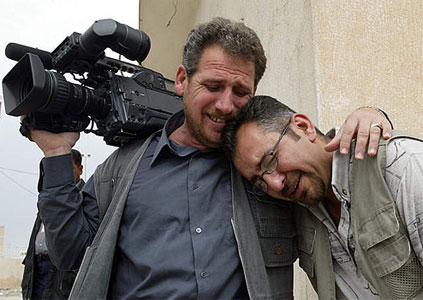 |
Baghdad, March 19, 2004 -- Iraqi cameraman Imad Andraus (left) of satellite channel Al Arabiya, and producer Menhel Akram of Associated Press Television News, crying during the funeral for two of their colleagues shot dead in an incident involving U.S. troops the night before. Employees of Al Arabiya say U.S. soldiers opened fire on a car carrying an Arabiya crew on Thursday evening after another automobile ran through a checkpoint. Cameraman Ali Abdelaziz was killed and correspondent Ali al-Khatib died in a hospital on Friday morning. |
Photograph by Ammar Awad/Reuters |
Imagine what it would have been like to see the war in Vietnam covered by the Viet Cong – or the Holocaust covered by Jews? Blaming Al Jazeera and its competitor Al Arabiya for “cooperating with Iraqi insurgents to witness and videotape attacks on American troops,” for providing propaganda for the enemy, the United States government does not seem to realize to what extent its own press so often does the same.
Or as a major American newspaper put it when I suggested to them that they publish photographs of the American war dead on the first anniversary of the invasion: “It is too political.”
- Fred Ritchin
October 5, 2004